
Clay County Deed Types
The Clay County Clerk recording office handles deeds and every related land instrument. Its series cover mortgages, liens, plats, releases, wills, condominiums, corporate records, and UCC fixture filings. Labels matter. Read the document type before deciding what a filing actually did.
| Deed Type | What It Does | Common Use |
|---|---|---|
| Warranty or special-warranty deed | Conveys land with the warranties stated in the instrument | Voluntary sale or transfer |
| Quitclaim deed | Conveys whatever claim the signer has without a warranty of clear title | Release or transfer of a claimed interest |
| Correction deed | Corrects the cited original while keeping the same parties | Fixing a stated recording error |
| Commissioner or sheriff deed | Records a transfer tied to a court or statutory process | Court sale or tax process |
| Estate transfer document | Connects will, descent, or heirship facts to land | Death-related ownership change |
Mortgages, liens, lis pendens, easements, assignments, and releases are not deeds. A release can clear an old mortgage. A lis pendens can warn of a pending court fight. Each of these instruments burdens, secures, transfers, or ends an interest without changing the fee owner, so Clay County deed records must be read alongside the parallel series for a sound title history.
Clay County Recording Requirements
Clay County's deed checklist from the Clerk asks for grantor and grantee names, mailing addresses, the consideration paid, a legal description, source of title, a preparer statement, a return address, a tax-bill in-care-of address, signatures, and notarization where it applies. Record the deed in the county holding the property. If most of the land sits in Clay County, that is where it goes. These details matter. A complete instrument image carries far more than a short index row ever will.
The transfer tax works out to fifty cents per five hundred dollars of value under KRS 142.050, and the grantor usually pays it. Almost every deed needs a consideration certificate. A few stated categories are exempt. Even a gift deed, or one with nominal consideration, may call for an estimated fair cash value. Confirm the current rate and fees with the recorder at filing time.
A correction deed has a narrow job. It must cite the original deed, state what changed, and keep the same grantor and grantee. Parties cannot be added or dropped. Treat it as a companion to the first deed, never a replacement that erases the prior record.
See Clay County Recording Categories
The Clerk groups every land series on one official page. That grouping prevents a deed-only search from missing a release, plat, or estate filing. The Clay County recording categories page is the official entry point for land-record requests.
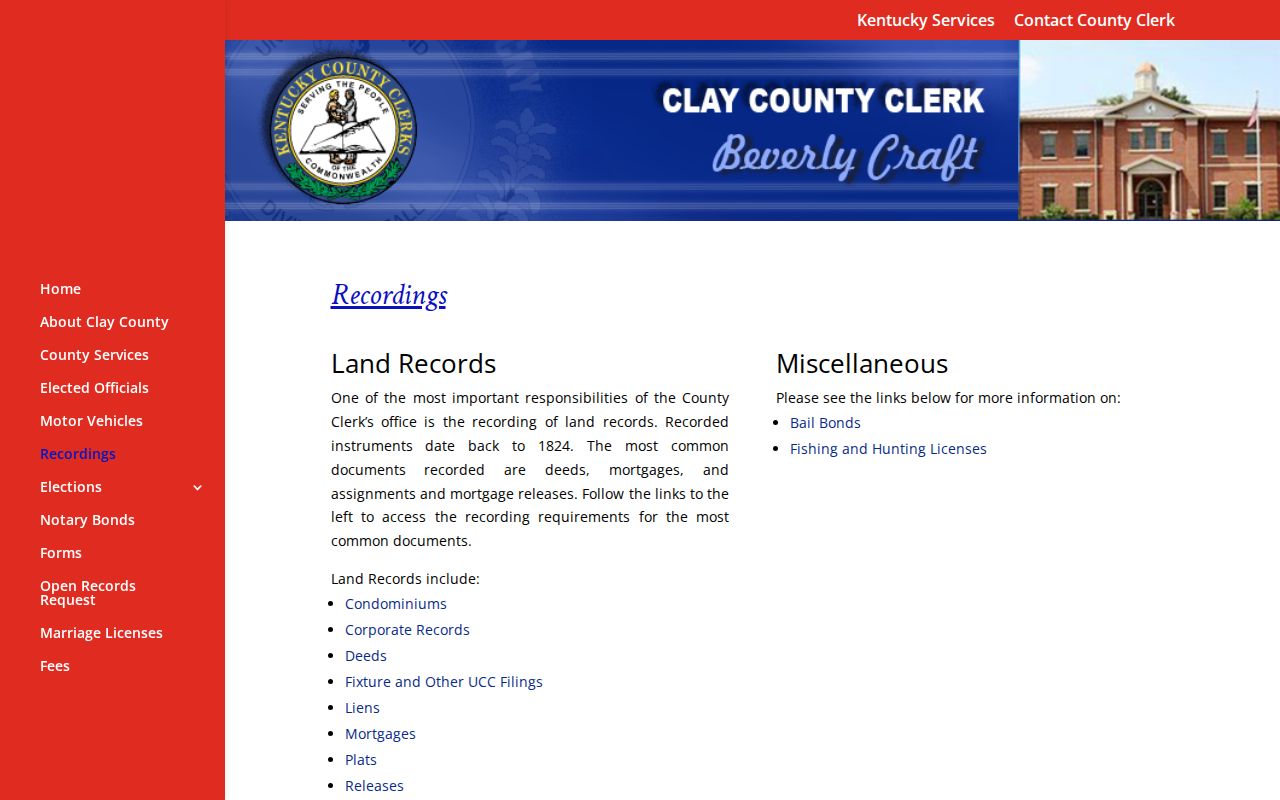
The official page confirms the category route. It cannot replace a live index result or a certified copy of a recorded Clay County deed.
Clay County Grantor-Grantee Chain
Clay County publishes no online deed index. Use the County Clerk instead. An in-office index works too. A written request or historic KDLA microfilm are other routes. Search both directions. A grantee entry marks a purchase coming in. A grantor entry may mark a later transfer out. Trustee, executor, commissioner, sheriff, and business names can also carry a transaction. Each one can move a transaction through the deed records.
- Begin with the latest confirmed owner and find that party as grantee. Request the full deed, not only its index entry.
- Read the grantor and the source-of-title book and page. Compare the legal description before treating it as the same tract.
- Search that grantor as a prior grantee, then repeat. Search the grantor side too so an intervening transfer is not missed.
- Check correction, commissioner, sheriff, and estate deeds plus plats, releases, liens, and lis pendens alongside the chain.
- Grantor
- The party conveying the stated interest.
- Grantee
- The party receiving the stated interest.
- Chain of title
- The linked sequence of instruments affecting the same land.
- Book and page
- The recording reference used to retrieve an instrument.
Match Clay County Legal Descriptions
The legal description survives every address change. A Clay County tract may run by metes and bounds, monuments, adjoining owners, a creek, road, branch, ridge, survey, patent, tract name, or lot and block. Mineral, coal, timber, easement, and right-of-way wording can matter as much as the street address. So read it closely.
Capture every exception, reservation, exhibit, and source-of-title citation. A parcel on the tax roll can combine land differently from a deed tract, mineral estate, condominium unit, or easement. If a GIS line and the deed wording conflict, keep both versions. Ask a Clerk, PVA, title, or survey professional to resolve it. Do not trust the closer-looking shape.
Search Clay County Parallel Filings
A deed chain cannot answer everything. It will not show whether a mortgage was released. It will not show whether a lien still stands. It will not show whether a court action touched the land. Search mortgages with their assignments and releases. Search easements under both parties and every affected parcel, since the Clerk indexes those instruments. Review plats and master deeds. Review fixture filings, estate affidavits, wills, judgments, and lis pendens on their own terms.
A quiet-title or foreclosure notice is only a lead. One 2025 Clay County notice cites 106 Walters Street, Map ID 082-42-09-003.00, and Circuit Court case 25-CI-00191. Those keys route a records request. The notice itself is not a judgment or final deed. Pull the court file. Then look for a recorded commissioner deed, release, redemption, or other outcome.
Reach Historic Clay County Deeds
Deed research in Clay County reaches surprisingly far back. The Clerk reports recorded instruments dating to 1824. The KDLA County Records Inventory lists Clay deeds running from 1807 through 2009. Neither marker is complete. They show the span of surviving material, not that every deed still exists or sits online.
Boundary history matters here. Clay County was formed in 1807 from Madison, Floyd, and Knox counties and later gave up land to newer counties. Match each deed to the county lines in force on its date. From about 1890 onward, deeds routinely cite prior recordings, which makes chain-building easier. Earlier gaps may call for the KDLA tax assessments identified for 1808 through 1925. A tax entry can support a chain of ownership, but it never proves title.
Keep a full physical citation at every step of older work. That means the county, deed book, page, index side, party spelling, instrument date, recording date, and microfilm roll. The roll matters when one is supplied. The KDLA inventory also points to Clay wills from 1826 through 2008. It lists civil cases from 1807 through 1986. It lists county order books from 1855 through 1886. These series can explain an estate transfer, a court-ordered sale, a road matter, or another break in a normal chain of title. Use them to locate the underlying land instrument rather than as a substitute for it.
Neighbor clues are powerful. A deed may name an old adjoining owner or a branch. Run that phrase through the same-era grantor and grantee indexes. Then compare the tract call against later source-of-title references. Parent and successor county records deserve the same treatment, since the record jurisdiction moved as county lines did. Note why each outside-county volume was checked.
Local industries sharpen the search too. Coal, timber, logging, salt, roads, hollows, and creeks all add useful terms. The historical society's reported 1903 Clay County Plat Book offers a map clue. It must be weighed against later deeds and parcel splits, though.
Request Clay County Deed Records
Reach County Clerk Beverly Craft at 102 Richmond Road, Suite 101, Manchester, KY 40962; by phone at 606-598-2544; fax 606-599-0603; or email beverly.craft@ky.gov. Ask whether a public terminal, vendor index, or image service is available now. Supply party names, deed type, approximate date, book and page if known, parcel key, and any legal-description clues.
You may deliver an open-record request by hand, mail, email, or fax using the Attorney General form or a written request. Include contact data, Kentucky residency, the precise documents wanted, and helpful search facts. Fees are prepaid, and the published response period is five business days. The Clerk fee page carries a 2020 label, so confirm its amounts before relying on them.
Note: Ask whether the copy is plain or certified and request each page, exhibit, stamp, and marginal reference tied to the instrument.
Read the Clay County Fee Page
The Clerk maintains a public fee page, and its title expressly reads 2020 Fee Schedule. That date belongs with every figure taken from it. The schedule lists example charges for deeds, mortgages, plats, releases, wills, and fixture filings, plus extra page or reference fees in some cases. It cannot confirm what the office charges today. Treat it as a historical reference point, not a current price list. The posted Clay County Clerk fee schedule appears here.
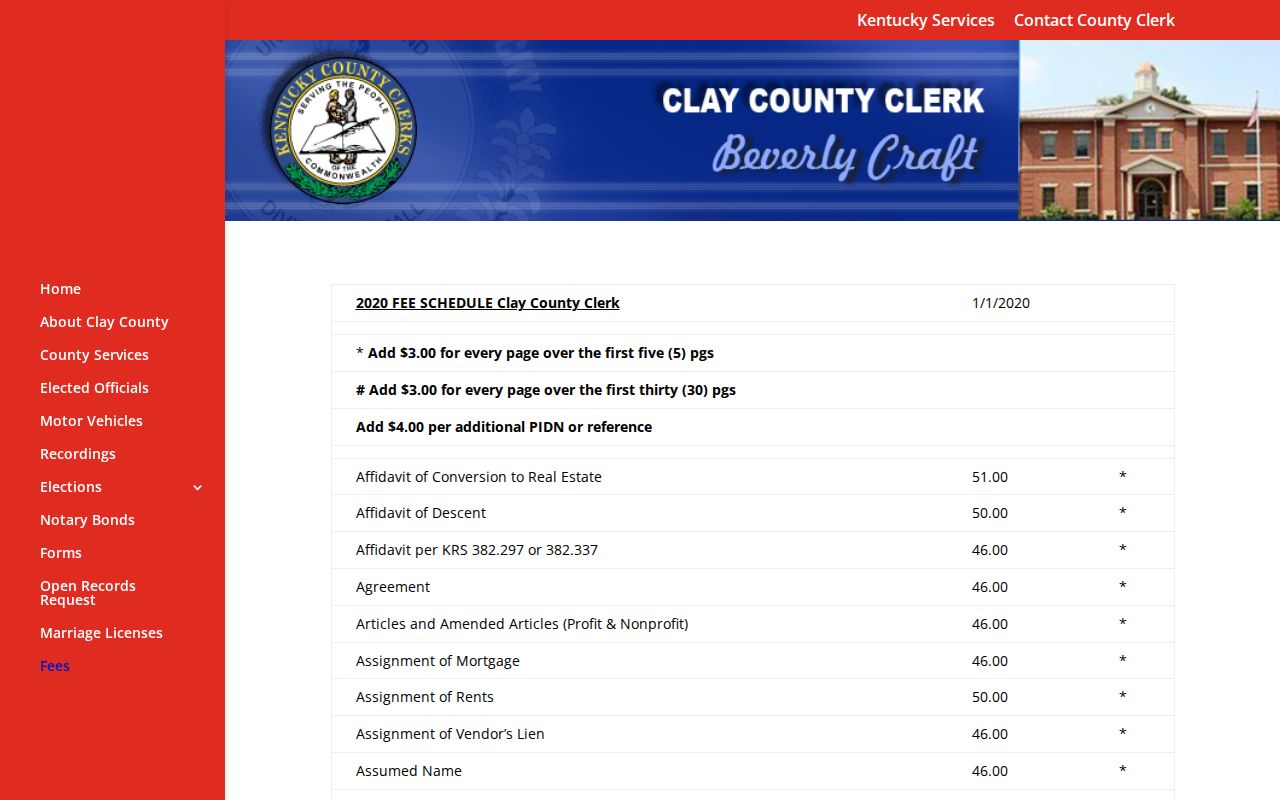
A dated schedule still has value as a record of what the office charged. For a current total, ask the Clerk directly based on document type, page count, references, and whether certification is needed.
Verify a Clay County Deed Copy
When a copy arrives, verify the details against what you asked for. Confirm the county, instrument type, record stamp, grantor, and grantee. Check the legal description, source of title, and consideration statement too. Review the signature, acknowledgment, and any attached exhibits. Follow separate references to plats, easements, mortgages, assignments, releases, and corrections. Remember that one tract's deed does not prove another parcel was conveyed. That holds even with the same address or owner.
The posted 2020 fee schedule offers dated examples. It lists a fifty-dollar deed and separate prices for mortgages, plats, releases, wills, and fixture filings. Those are posted figures, not a confirmed current price list. Request a quote before sending payment. For tracing the chain further back, see the former owners page.
Certification has a narrow meaning. A certified copy proves the copy came from the custodian. It does not prove the deed created good title. Check whether later corrections, conveyances, releases, court orders, estate documents, or parcel splits changed the record after filing. Keep the complete recording stamp and certification with your copy.
Recorded, not guaranteed. Clay County deed records show what reached the Clerk. They do not prove clear title or rule out an unrecorded interest.