
Trace Clay County Former Owners
A backward chain has to begin with a real transfer rather than an imagined example. Log one row per deed and copy the recording reference exactly as it appears.
| Transfer date | Grantor to grantee | Deed type | Book and page |
|---|---|---|---|
| Newest recorded date | Prior owner to current grantee | As recorded | Source-of-title reference |
| Next earlier date | Earlier owner to prior owner | As recorded | Cited volume and page |
| Continue backward | Repeat for the same tract | Note court, estate, or correction form | Preserve each reference |
Accept the next link only when the legal descriptions, parcel clues, acreage, and adjoining owners line up. Names alone prove little, since one person often held several tracts.
Read Clay County Deeds Backward
The Clay County Clerk is where deeds and land instruments get recorded. The office publishes no grantor-grantee portal. Chain work may therefore take a counter visit. It may also take a phone call or a precise written request. Search the index in both directions and save the source-of-title citation.
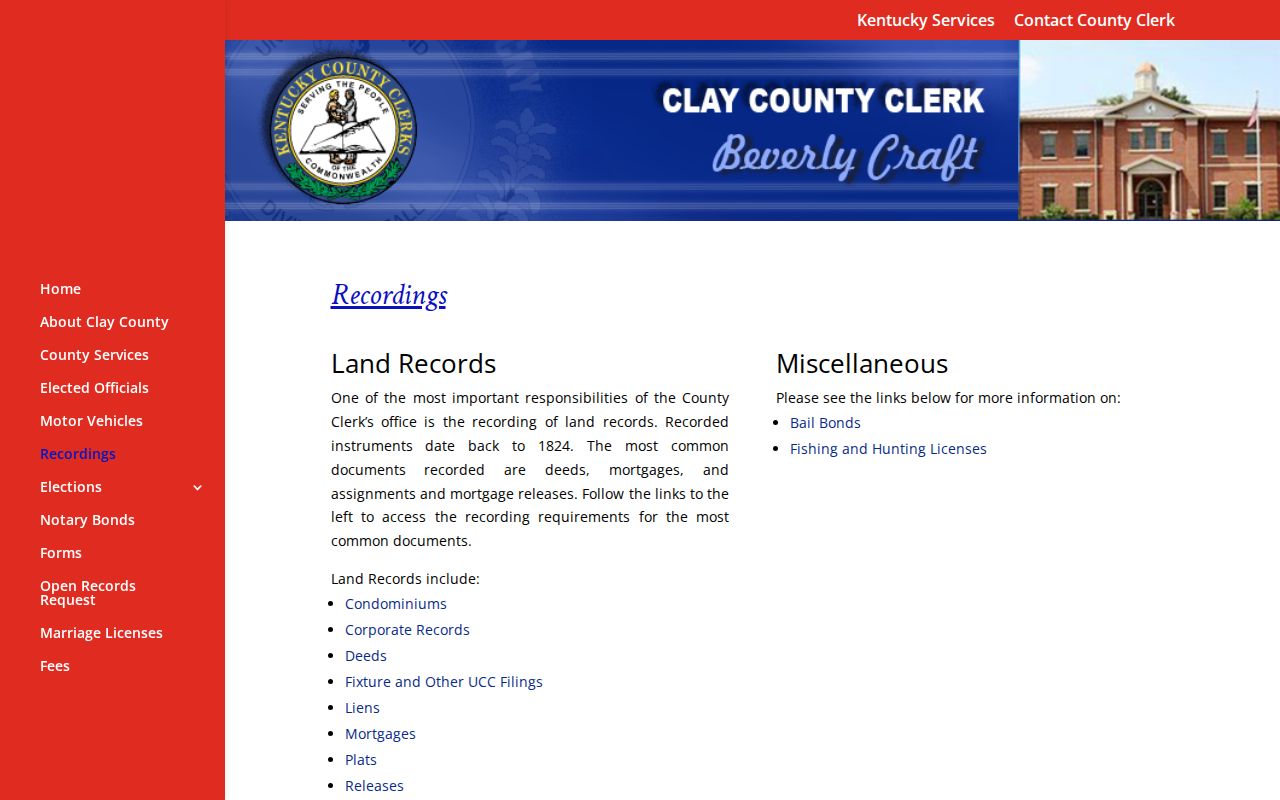
The Clerk's page lays out the recording categories and notes how far local instruments reach back. The owner chain itself still comes from the parcel's deeds and their cited books.
- Find the newest deed for the known owner as grantee.
- Read the grantor and full legal description.
- Search that grantor as a grantee in an earlier period.
- Compare the earlier deed to the same tract.
- Repeat until books or archive holdings require another route.
- Grantor
- The party conveying the described interest.
- Grantee
- The party receiving that interest.
- Chain of title
- The linked sequence of conveyances for the same land.
- Reverse index
- An index useful for searching by receiving party.
- Quitclaim
- A transfer of whatever claim the grantor may hold, without a title warranty.
Clay County Archive Depth
The KDLA County Records Inventory lists Clay deeds from 1807 through 2009. It also covers wills from 1826 through 2008. The Clerk page separately places instruments as early as 1824. Treat those as the earliest holdings, not an online cutoff. Clay County offers no public deed portal. When a local search reaches older volumes, turn to the KDLA microfilm inventory and the state records-request service. Name the county, the series, the years, the parties, and the book and page. Remember that the inventory itself warns it is not comprehensive.
Online limit. Former-owner research extends beyond the web. Earlier links require deed books, microfilm, or archive requests.
Clay County Tax List Clues
KDLA material places Clay tax assessment holdings between 1808 and 1925. A tax entry puts a name with land in a given year. It never replaces a deed. Use it to bridge a gap or test an approximate transfer date. Clay County formed on April 1, 1807. Later divisions shifted jurisdiction. A chain crossing those changes needs the county that held the deed at the time.
Clay County Plat Book Trail
The Clay County Genealogical and Historical Society reports a unique 1903 Clay County Plat Book among its plat and directory holdings. It can yield an early layout clue. Do not assume it matches parcel lines after later splits or conveyances. Old descriptions lean on landmarks instead of house numbers. They name Redbird, Goose Creek, branches, ridges, minerals, timber, and roads. Coal, salt, logging, and farm terms can steer searches for deeds, leases, reservations, and rights-of-way.
Clay County Estate Links
A death can break a deed-to-deed chain. Kentucky routes probate through District Court. The County Clerk then records the will or a real-property affidavit. Search deeds, wills, affidavits of descent, heirship material, and court files as separate series. A death certificate helps with identity and timing. It conveys nothing. Commissioner's deeds, sheriff's deeds, foreclosures, and quiet-title actions deserve equal care. A public notice may carry a Map ID, address, case number, and sale date. But the final docket and recorded outcome still have to be pulled.
Request Clay County Deed Books
The County Clerk's open-records route accepts the Attorney General form. It also accepts a written request delivered by hand, mail, email, or fax. Identify the record series. List the parties, tract clue, approximate years, and every known book-and-page citation. The office requires fee prepayment. It states a response is due within five business days. Because the posted fee schedule is labeled 2020, confirm current copy costs before ordering a long run. At KDLA, preserve the county, series, roll, volume, and page in each request. If only a road or branch name survives, state that plainly. Do not dress it up as a legal description. When a response finds no index entry, record the exact spelling and years searched. Follow up with spelling variants or the other index direction.
Clay County Boundary History
Clay County was carved from Floyd, Knox, and Madison territory in 1807. Several counties later split from Clay. Estill came first in 1808. Perry followed in 1820, and Laurel in 1825. Owsley followed in 1843, then Jackson in 1858 and Leslie in 1878. A tract sitting in Clay today may have followed a different records path. Its paper trail can run through an early boundary. Begin with the deed date, not today's outline. Establish where the land lay when the deed was recorded. Then check the parent or successor county as the chronology demands. This jurisdiction check often explains a gap. No amount of surname searching in one Clay index will fix it.
Manchester Enterprise Ownership Clues
Newspaper files offer some of the best ownership clues in Clay County. The Clay County Public Library holds Manchester Enterprise material going back to the early 1900s. A single notice can surface a former owner's name. It can also surface a road or tract description, estate context, a court case, or a sale date. Note the issue date and page. Then pull the deed, probate, tax, or court record that sits behind the story.
Local coverage earns its keep when a road name has changed. It also earns its keep when a transfer moved through an estate or court sale. Treat it as a discovery source, nothing more. A printed notice never proves a sale closed. It also never proves a deed was recorded, a lien was released, or a judgment became final.
Grade Clay County Chain Links
Not every link in a Clay County owner chain carries the same weight. A strong prior-owner link matches the deed book and page, the parties, the legal description, and the acreage or lot. It also carries the source-of-title reference. A medium link may match owner, road, and tax year yet lack the deed image. A weak link holds only an address, a notice, or a historical name. Grading each link keeps a plausible clue from hardening into an unsupported chain.
Old deeds often disagree with each other. When two descriptions vary, compare the calls to branches, ridges, adjoining owners, roads, and lot and block. Check mineral reservations and later parcel numbers as well. A newer map can orient the tract. It cannot rewrite the historical deed. Preserve the exact conflict so a surveyor, attorney, archivist, or custodian can weigh it.
Clay's mountain terrain helps here. Road and branch terms can survive across several deeds even as acreage shifts. Set those calls against reservations for coal, timber, minerals, access, or utilities. A surface conveyance may not describe every separate interest tied to the tract.
Keep a parallel log for releases, mortgages, assignments, easements, liens, and plats. Track affidavits of descent and will transfers there too. Those instruments may explain why a surname reappears. They may also show why an estate stands between two deeds. They belong beside the chain, never inside it as new conveyances.
A former owner's deed will often cite another source of title. Copy that citation before you leave the volume. It is the fastest route to the next older link in the chain, and it helps separate a true predecessor from someone named only as a spouse, witness, lienholder, adjoining owner, or court party.
Clay County Prior Owner Limits
Know the limits of each record type. A quitclaim may convey only the claim its signer held. A correction deed cannot add or remove parties. Plats, map labels, tax lists, and notices are leads rather than final title proof. Date every source. When records conflict, preserve the exact name, deed type, legal description, and volume reference. Kentucky records may expose addresses and signatures. KRS 61.878 protects exempt information. Use only what the parcel question needs. Research into former owners still serves house history, purchase diligence, estate work, and title questions.
Lawful use. Never use Clay County former-owner records to track, stalk, harass, intimidate, or harm a living person.