
Meaning of Clay Property Values
The Clay County Property Valuation Administrator wears several hats at once. The office assesses real estate, maintains the roll and maps, tracks ownership changes, and updates building characteristics. Its assessed value serves the tax system. Kentucky defines fair market value as the price reached in a fair, voluntary sale. A deed tells a different story. Its stated consideration records the transaction language. But the transfer might be a gift, a nominal sum, an exempt transfer, or another qualified event.
| Value type | What the figure means | Record source |
|---|---|---|
| Assessed value | Value entered on the assessment roll for taxation | Clay County PVA card |
| Fair market value | Estimated price in a fair voluntary sale | PVA valuation work or appraisal context |
| Sale consideration | Amount or transfer statement carried by the deed | County Clerk instrument |
| Taxable assessment | Assessment after an applicable exemption | PVA and tax record |
Related, yes. Interchangeable, no. The tax bill also turns on tax rates, exemption treatment, and collection status, and the PVA sets none of those rates or collects any of that revenue. Billing belongs to the county's property tax records. This comparison stays focused on what each value actually means.
How Clay Property Is Assessed
Kentucky guidance accepts three appraisal methods. Sales comparison weighs recent market transfers. Cost adds land to improvements. Income analysis fits property that produces income. The best method depends on the property and the evidence the assessor holds. A mass assessment applies consistent methods across many parcels. A private appraisal examines one assignment with its own effective date.
The Kentucky Department of Revenue assessment process also explains annual revaluation authority. It covers a four-year physical inspection cycle too. Building characteristics, sketches, land data, and observed changes can all move the record. Before assuming the number tracks every market event, ask which fields and which year support the current Clay County property value. The state assessment method is laid out in the official DOR source.
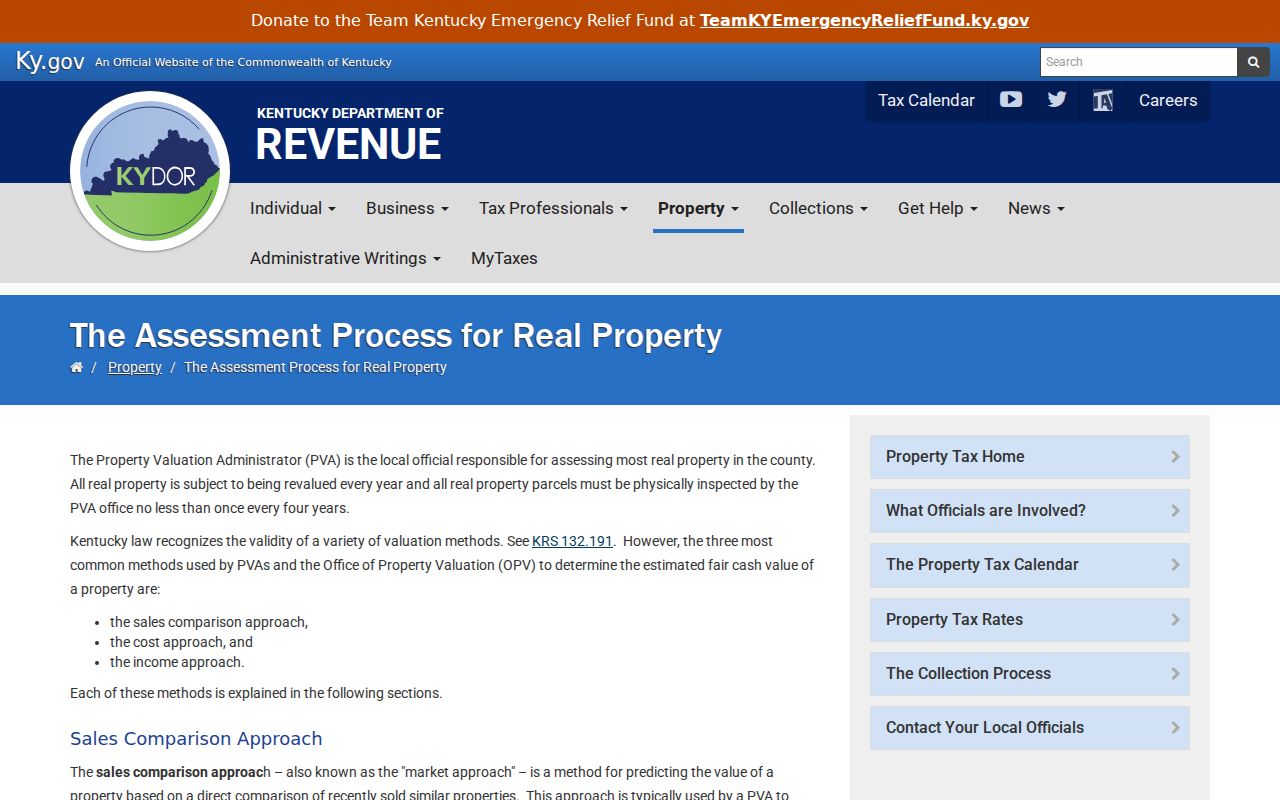
That statewide framework sets the rules. The Clay PVA remains the source for a parcel's current card and field values.
Check a Clay County Property Value
The Clay PVA publishes no public parcel-card search interface. The documented route runs through the GIS viewer first, then a direct PVA request. That limitation is worth keeping in mind. A map field can help identify the parcel, but it never replaces a current assessment card.
- Search the Clay County Interactive Viewer by street, owner, PIN, or parcel number.
- Copy the selected parcel key exactly, including punctuation, decimals, and leading zeros.
- Ask the PVA for the current card, value year, land and building fields if available, exemption status, and last roll update.
- Compare a stated sale with the latest recorded deed, while noting whether the consideration is nominal, exempt, or qualified.
- Use a licensed appraisal when the question is a current transaction value rather than the public assessment.
- Assessed value
- The value placed on the assessment roll for the tax system.
- Market value
- The estimated price in a fair voluntary sale.
- Assessment ratio
- The relationship between assessed and market value when a jurisdiction uses a stated level.
- Consideration
- The amount or value statement associated with a recorded transfer.
- Reassessment
- A later review that may change the roll's value or characteristics.
Clay Values Use a Tax Date
The Kentucky property tax calendar uses January 1 ownership for the assessment year. A deed recorded later can leave the new grantee, the PVA owner field, and the tax-bill name out of step. An "in care of" mailing line hints at timing. It proves nothing about ownership.
Record the date on every source. A value from one assessment year should not be paired silently with a deed from another, and the same caution applies to a court notice or public sale document that repeats an older Map ID or value for its own legal purpose.
Exemptions Change Clay Taxable Value
An exemption can shrink the taxable assessment while leaving the underlying fair market value untouched. Kentucky DOR publishes a homestead deduction for qualifying taxpayers. Eligibility and the amount can change, so confirm both. Apply it only when the PVA record shows the exemption. Age, a mailing address, or apparent occupancy never proves eligibility on its own.
The distinction matters when two nearby parcels look alike but carry different taxable values. Before concluding anything, compare the land, building, total assessment, classification, exemption field, and value year. Questions about the bill belong with Clay County property tax records. So do delinquency questions and appeals.
Clay Deed Prices Need Context
The Clay County Clerk deed requirements cover consideration and transfer-tax material. Not every transfer is a market sale. A deed may record a gift, a family conveyance, an estate transfer, a correction, or a quitclaim. So the amount on one instrument is not always a clean comparable. Read the deed type, consideration certificate, parties, legal description, and source-of-title citation together.
A sale can also cover more or less land than the assessment parcel now displays. Lot splits, mergers, mineral interests, easements, or several tracts bundled into one deed can occur. Any of these can break a direct price-per-parcel comparison. Preserve parent and successor parcel IDs. Ask the PVA which land the value covers.
Clay Property Details Affect Value
The PVA keeps building characteristics and maps as part of its assessment role. Land size, use, improvements, and inspection findings may all support the roll. Clay County's mountain terrain adds practical context. Wooded acreage, branch or hollow access, timber, coal, mineral reservations, and older tract descriptions can all affect how records must be matched. Those features should come from the official card and recorded instruments. Never rely on assumptions based on an aerial view.
Note: Ask for the current parcel card when a building change, lot split, or new deed may post after the value now in hand.
Compare Clay Value Records
A good comparison table starts with its labels. Name the source, the effective date, and the parcel identity. Enter the PVA assessment as an assessed figure. Record deed consideration as a transfer figure tied to its deed type. Enter a private appraisal only as an opinion, with its own effective date and purpose. Never average unlike numbers. Do not crown the highest figure as market value without support.
Sales still help when the records match. Confirm the deed covers similar land and improvements. Check that the transfer was voluntary and that its date fits the valuation period. Clay's rural tracts can look alike on paper. They can differ in acreage, access, timber, minerals, and legal description, even when their mailing addresses sit close together. An assessment record can also trail events. A new building, demolition, split, or merger may not appear on the card yet.
When a value looks wrong, start with the PVA. Ask for the current card and each field's basis. Keep photographs, measurements, deeds, plats, and sale evidence tied to the parcel. That is evidence gathering, not a prediction of what any review will produce.
A court notice is not a stand-alone valuation. Clay's tax-sale and court public-notice samples can carry an address, Map ID, tax year, case number, or sale setting. But the publication serves a legal notice purpose. It may not state the final sale result or the current assessment. Check the court file, the deed recorded after the event, and the PVA card. Only then weigh those figures against a Clay County property value. Infrastructure news deserves the same restraint. County notices name road and water projects. Those can lead to resolutions, easements, bids, or right-of-way files. An announcement alone proves no value change. It proves no easement either. Search by the project and road name. Then require a parcel-linked instrument before treating the event as part of the property's record.
Clay Property Value Limits
A Clay County assessed value is a tax record, nothing more. It promises no sale price, settles no title, and proves no boundary. It cannot replace a condition inspection either. The figure may lag a recent transfer or a physical change. Buyers and sellers can agree on a price above or below the tax roll, and a licensed appraiser can still reach a market opinion for a stated purpose and date.
Keep a source label on every number. Call each figure what it is: assessment, deed consideration, tax bill, court notice, or appraisal. The habit pays off. It keeps a dated public figure from being passed off as what the land is worth today.
Value is not price. Clay County assessed value supports taxation. It is not a prediction of sale price and is not a private appraisal.