
Clay County Owner Record Card
The Clay County PVA keeps the assessment roll, county maps, ownership changes, building characteristics, and exemptions. The office publishes no public parcel-card portal. A current owner check therefore starts with a call to the PVA or with a parcel discovered in the county GIS viewer. Ask for the current card and its effective date.
| Owner name | The assessment owner shown for the parcel |
|---|---|
| Mailing address | Where assessment or tax mail is directed |
| Situs address | The parcel's physical location, if assigned |
| PIDN or parcel ID | The key used to match map, roll, and deed |
| Last transfer clue | Date or deed reference if present on the card |
| Assessment facts | Acreage, improvements, value, and exemptions maintained by PVA |
The card does not show who occupies the site. A mailing address may be a post office box, an out-of-county address, or a care-of contact. Keep that distinction visible whenever the current owner record is used.
Request Clay County Owner Data
To reach the Clay County PVA office, visit 102 Richmond Road, Suite 200, Manchester, Kentucky 40962. The staff answers questions at 606-598-3832 or claycountypva@gmail.com, Monday through Friday from 8:00 a.m. to 4:30 p.m. When you call or write, describe the purpose as a current assessment-owner check. Include the GIS parcel number whenever you have it, since that detail speeds the search.
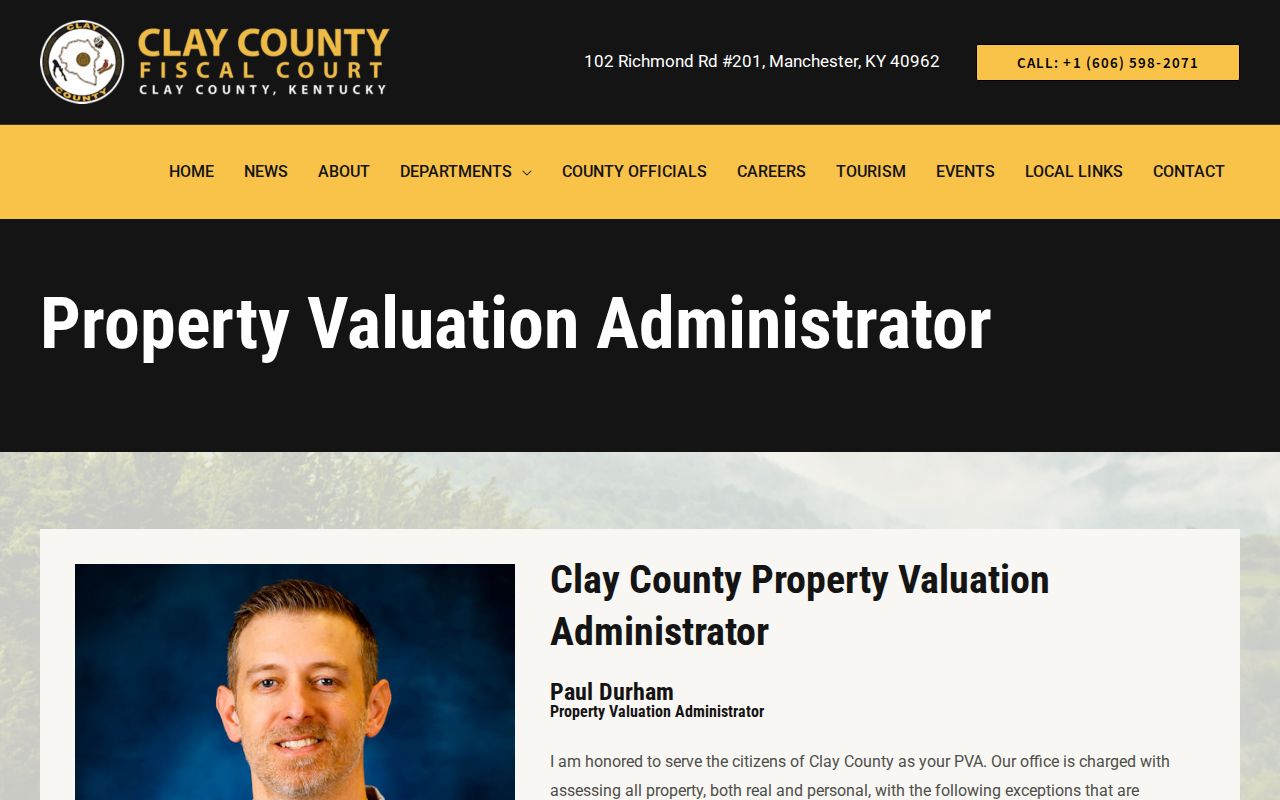
The PVA page outlines the office's assessment role and how to reach it. It displays no live parcel owner. Request the dated card for the specific land.
A useful request names the street exactly, notes any branch or hollow spelling, includes the owner variant from GIS, and asks for the card date. The PVA can clarify the roll. It cannot issue a title opinion, set tax rates, or collect the bill.
How Current Clay County Owners Are
Clay County makes no promise that GIS, the assessment roll, the deed record, and the tax bill refresh together. After a closing, check the newest recorded deed. The PVA card still governs the assessment owner as of its effective date. Save both dates.
Kentucky uses January 1 ownership for the current tax year. A sale after that date can leave the earlier owner on the bill while the new owner appears in care of for mailing. That phrase is a timing clue. It never proves the care-of party holds title.
Recent sale check. The Clay County owner of record on a roll can lag a conveyance. Compare it with the newest deed recorded by the Clerk.
Verify the Clay County Owner
The Clay County Clerk recordings page names the local recording office for deeds and related instruments. The county offers no public deed-search portal. Use the counter, phone, or open-records request. Include the current owner spelling, parcel ID, location, and a short date range.
- Get the current PVA parcel card and write down its effective date.
- Match the PIDN and situs description to the Clay Interactive Viewer.
- Ask the Clerk for the latest deed that conveys the same parcel or legal description.
- Read the grantee, recording date, deed type, and source-of-title book and page.
- Record any mismatch without deciding that one source is wrong.
The wider address-to-owner route is covered under who owns a Clay County property. This check stays on the roll and latest deed.
Clay County Owner Terms
A few Clay County record terms prevent common mistakes, since they describe a source or role rather than a final legal conclusion.
- Owner of record
- The party shown as owner on the named official record and date.
- Assessment roll
- The PVA's property list used for assessment work.
- Situs address
- The location of the land, distinct from the mail address.
- Recording lag
- Time between a transfer and its appearance in another county system.
- Grantee
- The party receiving the interest described by a deed.
Vesting describes the interest a deed gives the grantee. Clay records may instead show an LLC, trust, estate, or more than one grantee. Never swap the record name for a person silently.
Clay County Business Owners
An LLC named as the current owner should be searched under its exact legal name through the Kentucky Business Entity Search. That result shows entity status and filed records. It never makes the agent the land's personal owner.
For trusts or estates, ask the Clerk about deeds, affidavits of descent, and recorded will-related documents. Probate runs through District Court. Keep roles separate. An executor, trustee, heir, or care-of recipient is not the grantee in the recorded conveyance.
Check Clay County GIS Labels
The Clay County Interactive Viewer accepts PIN, parcel number, owner, or street searches and toggles visible map layers. Use it to find the parcel and compare a displayed owner name, not to prove present title. The viewer publishes no layer-refresh date.
Exact-match searches are case sensitive. Suffixes matter too. In rural Clay County, branch, hollow, ridge, and road names often beat a partial street number as clues. Let that parcel identifier lead every later request.
Note: Save the map scale, visible layers, exact search string, match setting, and access date with every current-owner result.
Resolve Clay County Owner Mismatches
Log a mismatch before you try to explain it. Write down the exact PIDN, the legal description, the deed recording date, the PVA effective date, the tax year, and the GIS access date. Owner names drift apart for ordinary reasons. Punctuation, initials, a care-of line, an estate label, a parcel split, or a plain delay between systems can push one office's spelling away from another's. The land description and parcel key matter more. A rough name match proves little. Names are the weakest clue.
When the GIS and the PVA disagree, ask the PVA which source and date drive the assessment roll. If the roll lags behind a recent closing, ask the Clerk to confirm the newest recorded conveyance. A mismatched legal description is a stop sign. Check for a parent tract, a correction deed, or a separate parcel rather than trusting the newest-looking name.
Clay County Current Owner Requests
The Clay County Clerk handles open-records requests for recorded documents. A written request or the Attorney General form can go in by hand, mail, email, or fax. It should name the requester, confirm Kentucky residency, give contact details, and describe the precise record plus any helpful search facts. Fees are prepaid, and the office allows five business days to respond.
A present-owner question works best as a request for a specific newest deed, not every record under a broad surname. Supply the parcel ID, situs, grantee spelling, and a rough recording window. File a separate PVA request for the current assessment card and its effective date. Splitting the two keeps the assessed owner distinct from the recorded grantee.
Contact details for the Clay County Clerk: 102 Richmond Road, Suite 101, Manchester, Kentucky 40962; phone 606-598-2544; fax 606-599-0603; Beverly.Craft@ky.gov. Say whether an ordinary or certified copy is wanted. Verify the current charge, since the posted local fee page carries a 2020 label.
Older records follow a different path. The Kentucky Department for Libraries and Archives holds county inventories, microfilm listings, research guides, and its own records-request route. That archive route still cannot substitute for a fresh deed check when the question is who owns the property now.
A solid owner result carries a short provenance note. Record which custodian supplied it, the parcel key used, the access date, and whether the newest deed was checked. Clay County records shift between offices. The note keeps a saved screenshot or printout from looking fresher than its source.
Use Clay County Owner Records Lawfully
The assessment mail address is a record field. It is not proof of residence. Use only the minimum facts a lawful property matter requires, such as a purchase inquiry, boundary issue, estate question, or deed-fraud concern. Kentucky Open Records Act exemptions can still shield information even when most property records stay open.
A lookup is not a survey. It is not an appraisal or title search either. Mortgages, releases, easements, liens, and court orders can bind the parcel, so one source never tells the whole story.
Lawful use. Contact must stay tied to a legitimate property matter. Never use Clay County owner information to stalk, harass, intimidate, or harm a person.